
Table of Contents
ToggleHow Much Time Should You Expect to Invest?
If you’re starting your journey, one question is probably running in your mind: how much time it takes to learn digital marketing?
Is it 3 months? 6 months? 1 year?
The honest answer is — it depends on your consistency, learning method, and practical exposure. But don’t worry. In this guide, I’ll break it down in the simplest way possible so you can clearly understand what timeline to expect.
Digital marketing is a skill-based field. Unlike traditional degrees, you don’t need 3–4 years to become job-ready. With the right roadmap and daily action, you can start building real skills within months.
Why Understanding the Timeline Matters
- Helps you set realistic expectations
- Prevents overwhelm and confusion
- Helps you plan career switch smartly
- Keeps you consistent and motivated
- Saves you from wasting time on random tutorials
Let’s break this down step by step
How Much Time It Takes to Learn Digital Marketing for Beginners
There is no fixed number, but here’s a practical breakdown based on real-world learning patterns.
0–1 Month: Foundation Phase
This is your clarity phase. In the first month, focus on understanding:
- What is digital marketing?
- Major channels (SEO, Social Media, Paid Ads, Email Marketing)
- How businesses use digital marketing
- Basic marketing terms (CTR, CPC, ROI, Funnel)
Don’t try to master anything yet. Just understand the ecosystem. At this stage, many beginners get overwhelmed because they try to learn everything at once. Instead, focus on clarity.
Time required: 1–2 hours daily for 30 days is enough for basics.
2–3 Months: Skill Building Phase
Now you move from understanding to implementation.
Choose 1–2 core skills:
- SEO basics
- Content writing
- Social media marketing
- Basic Google Ads
Start practicing:
- Write sample blogs
- Optimize content
- Create social media pages
- Run mock ad campaigns
This is where learning becomes powerful — when theory meets practice.
Time required: 2 hours daily for 60–90 days
4–6 Months: Practical Implementation Phase
Now comes the transformation stage.
You should:
- Create your own blog or portfolio
- Work on small projects
- Help local businesses
- Do internships
- Build case studies
This phase is what separates learners from professionals.
Time required: 3–4 hours daily if you want to become job-ready faster
How Long Does It Take to Become a Digital Marketer Professionally?
Now let’s answer another popular question: how long does it take to become a digital marketer?
If your goal is:
Freelancing
You can start within 4–6 months if you:
- Pick one strong skill
- Build 2–3 case studies
- Offer services on platforms
Job or Internship
You can become internship-ready in:
- 3–5 months (with practical skills)
Full-time job-ready: - 6–8 months of consistent practice
Remember, companies hire based on skill — not certificates.
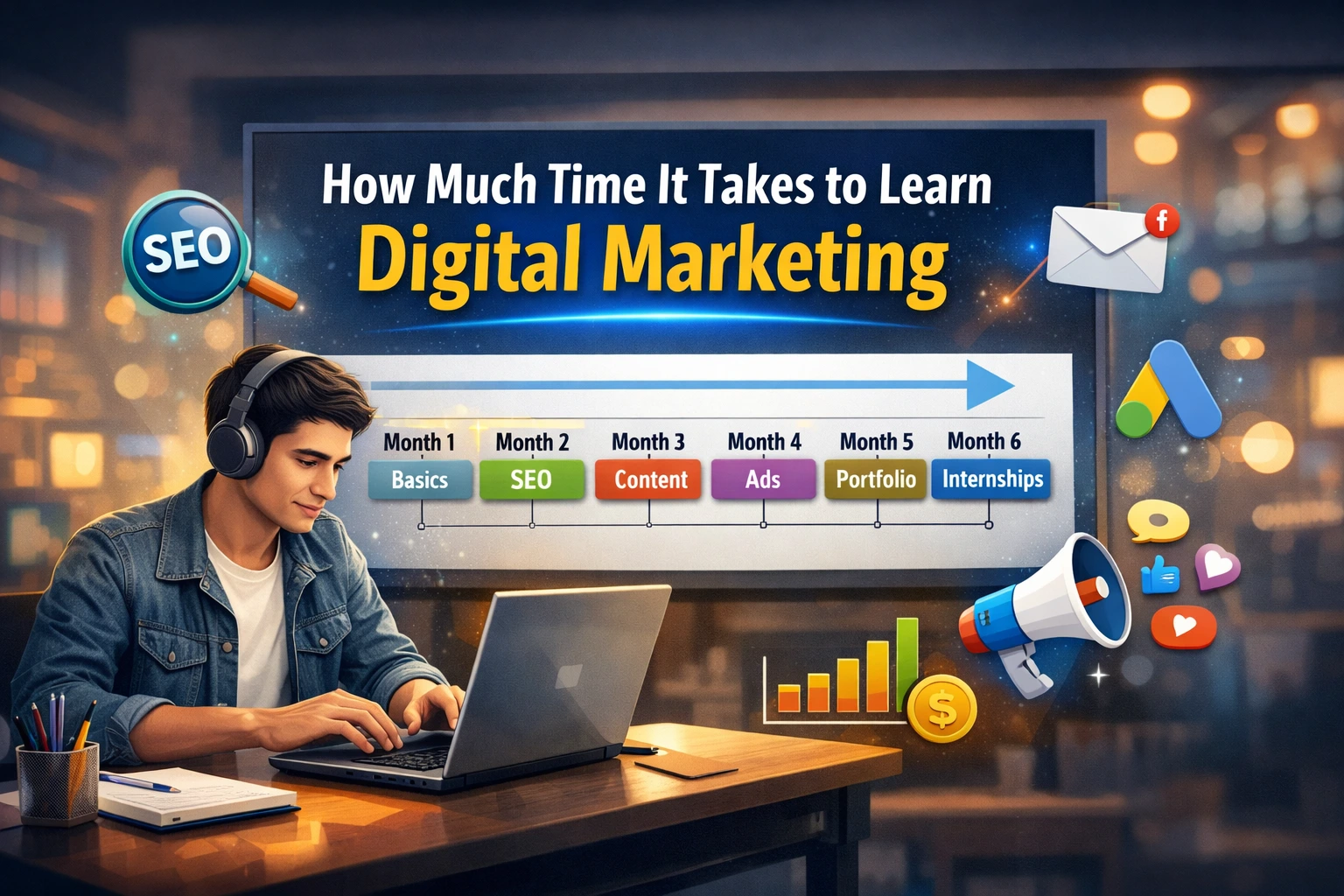
Digital Marketing Learning Roadmap (0–6 Months Plan)
Here’s a simple roadmap to learn digital marketing without confusion.
Month 1
- Learn basics of digital marketing
- Understand all channels
- Study real business examples
Month 2
- Start SEO basics
- Learn keyword research
- Understand on-page optimization
Month 3
- Start writing SEO blogs
- Learn basic analytics
- Explore Google Search Console
Month 4
- Learn paid ads basics
- Understand campaign structure
- Create sample ad strategies
Month 5
- Build portfolio website
- Publish blogs
- Optimize content
Month 6
- Apply for internships
- Start freelancing small projects
- Build LinkedIn presence
This road map of digital marketing keeps you focused without burnout.
Factors That Affect How Much Time It Takes to Learn Digital Marketing
Everyone’s timeline is different because of these factors:
- Daily Learning Hours
1 hour daily = slower progress
3 hours daily = faster growth - Consistency
Learning 30 minutes daily is better than 5 hours once a week. - Practical Practice
Watching videos ≠ Learning
Doing projects = Learning - Mentorship
If someone guides you properly, you avoid common mistakes. - Focus Area
Trying to learn SEO + Ads + Social Media + Email + Design at once slows you down.
Focus accelerates growth.
Common Mistakes That Slow Down Beginners
Many beginners think digital marketing is confusing. It’s not — the approach is wrong.
Avoid these mistakes:
- Watching random YouTube videos without structure
- Buying too many courses
- Not practicing
- Waiting to feel “ready”
- Ignoring analytics
Digital marketing rewards action, not perfection.
Expert Tips to Learn Digital Marketing Faster
Here are practical shortcuts:
- Build While Learning
Start a blog or Instagram page while learning. - Reverse Engineer Top Brands
See what competitors are doing and analyze their strategy. - Focus on One Core Skill
Master one skill deeply before expanding. - Track Your Learning
Maintain a progress tracker weekly. - Follow Industry Updates
Stay updated with Google algorithm changes and ad platform updates.
FAQs
1. How much time it takes to learn digital marketing from scratch?
With consistent daily practice, you can build strong fundamentals within 3 months and become job-ready in 6 months.
2. How long does it take to become a digital marketer without a degree?
You don’t need a degree. With 4–8 months of skill-based learning and practice, you can start working professionally.
3. Can I learn digital marketing in 3 months?
Yes, you can learn basics in 3 months. But becoming confident and professional usually takes 6 months of real practice.
Conclusion: So, What’s the Real Answer?
So, how much time it takes to learn digital marketing?
- Basics: 1–3 months
- Skill level: 3–6 months
- Job-ready: 6–8 months
The real secret is not time — it’s consistency.
If you stay focused, practice daily, and follow a structured roadmap, digital marketing becomes one of the fastest career skills you can build today.
What’s Next?
If you found this helpful:
- Drop your questions in the comments
- Subscribe to our newsletter for beginner-friendly guides
- Join upcoming practical workshops
- Explore affordable digital marketing courses
- Check recommended tools to speed up your learning
- Your digital journey starts with one decision — consistency.