

Table of Contents
ToggleLast Updated: April 2026
Introduction to Writing for SEO vs Writing for Users
If you’re starting your journey in digital marketing or blogging, one common confusion you’ll face is:
👉 Should I focus on writing for SEO or writing for users?
At first, it may seem like two different approaches. But in reality, the best-performing content is a combination of both.
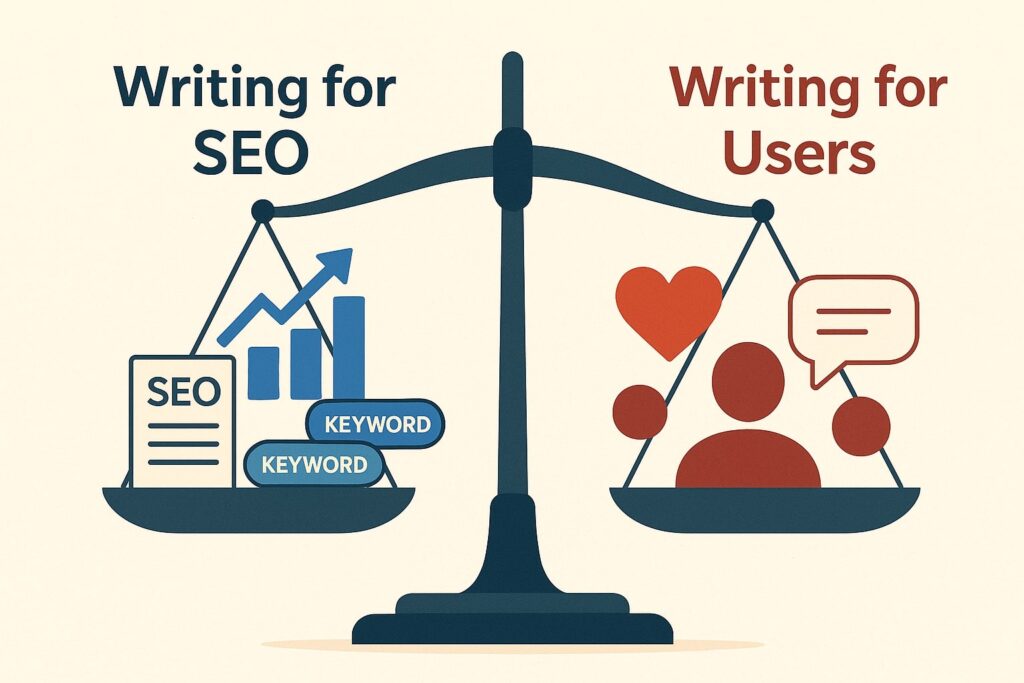
Writing for SEO vs Writing for Users is not about choosing one—it’s about balancing both effectively.
Search engines today are smarter than ever. They don’t just look at keywords; they evaluate how helpful your content is for real people. That means writing only for rankings won’t work anymore, and writing only for users may not bring traffic.
👉 You need both to succeed.
Why This Matters
Balancing SEO and user-focused writing helps you:
- Rank higher on search engines
- Keep users engaged on your page
- Build trust with your audience
- Increase conversions and clicks
In this guide, you’ll learn how to combine both strategies in a simple, beginner-friendly way.
What is Content Writing for SEO?

Content writing for SEO means creating content that helps search engines understand your topic and rank it for relevant searches.
It includes optimizing your content with the right structure and keywords.
Key Elements of SEO Writing
- Using target keywords naturally
- Writing clear headings (H1, H2, H3)
- Adding meta title and description
- Using internal links
- Structuring content for readability
But here’s something important: SEO is no longer about keyword stuffing.
Common Beginner Mistakes
- Repeating keywords too many times
- Writing unnatural sentences
- Ignoring readability
- Focusing only on rankings
What Works Now
Modern SEO focuses on:
- Search intent
- Content quality
- User experience
If your content answers user queries clearly, it has a higher chance of ranking.
What Does Writing for Users Really Mean?

Writing for users means creating content that is helpful, easy to understand, and valuable.
It focuses on solving problems rather than just ranking.
Example
❌ “Best SEO writing tips SEO writing tips best SEO tips”
✅ “Here are simple SEO writing tips you can start using today to improve your blog.”
The second version:
- Sounds natural
- Is easy to read
- Provides clear value
That’s user-focused writing.
Why It’s Important
When you write for users:
- People spend more time on your site
- They read more of your content
- They trust your information
These signals help improve your rankings as well.
Writing for SEO vs Writing for Users – Key Differences
Factor | Writing for SEO | Writing for Users |
Focus | Search engines | Readers |
Goal | Ranking | Engagement |
Style | Keyword-focused | Conversational |
Structure | Optimized | Easy to read |
Result | Traffic | Trust & retention |
The best strategy is to combine both.
Step-by-Step Guide to Balance SEO and User Content
1. Understand User Intent
Before writing, ask:
- What is the user searching for?
- What problem do they want to solve?
For example:
If someone searches content writing for SEO, they want to learn how to write SEO-friendly content.
Your blog should directly answer that.
2. Use Keywords Naturally
Include your keywords like:
- Writing for SEO vs Writing for Users
- content writing for seo
- seo writing tips
But avoid forcing them.
❌ “This content writing for SEO guide about content writing for SEO…”
✔ Use them naturally within sentences
3. Structure Content Properly
Make your content easy to read:
- Use headings and subheadings
- Keep paragraphs short
- Add bullet points
Most users scan content, not read every word.
4. Focus on Value-First Content
Ask yourself:
“Is this content actually helpful?”
Good content:
- Solves a problem
- Explains clearly
- Gives practical tips
5. Optimize Without Overdoing
Add:
- Meta title
- Meta description
- Internal links
But don’t over-optimize or make it robotic.
Good User Story Criteria for Better Content
User stories help you understand what your audience really wants.
Good User Story Criteria
A good user story should be:
- Clear
- Simple
- Problem-focused
- User-centered
Example
“As a beginner, I want simple SEO writing tips so that I can improve my blog ranking.”
This helps you:
- Stay focused
- Avoid unnecessary content
- Write more effectively
Great User Story Examples for Content Creation
Here are some practical examples:
- “As a blogger, I want to learn content writing for SEO so I can rank my posts.”
- “As a beginner, I want easy SEO writing tips to improve my writing.”
- “As a marketer, I want to balance SEO and user content to increase conversions.”
These help you align your content with real user needs.
Common Mistakes to Avoid
Avoid these mistakes:
- Keyword stuffing
- Writing only for search engines
- Ignoring user intent
- Poor formatting
- Overcomplicating content
👉 Fixing these can improve your blog instantly.
FAQs
1. What is writing for SEO vs writing for users?
It means balancing keyword optimization with user-focused content to create blogs that rank and engage readers.
2. How to balance SEO and user-friendly content?
Focus on user intent, use keywords naturally, and provide valuable, easy-to-read content.
3. What are the best SEO writing tips for beginners?
Start with user intent, write clearly, use keywords naturally, and structure your content properly.
Conclusion

Writing for SEO vs writing for users is not a choice—it’s a strategy.
👉 The best content:
- Ranks well
- Engages readers
- Provides real value
If you focus on helping users while optimizing for search engines, your content will perform consistently.
Let’s Connect
If you found this helpful:
👉 Drop a comment below
👉 Subscribe for more beginner-friendly guides
👉 Join my journey where I share practical digital marketing tips
I’ll also be sharing:
- Affordable learning resources
- Beginner-friendly workshops
- Useful tools to grow your skills