
Table of Contents
ToggleUnderstanding Pillar and Cluster Content in SEO
Have you ever wondered why some blogs seem to rank for everything while yours struggles to get even one article on Google’s first page?
I had the same question when I started DigitallyVin.com. I was publishing blog posts regularly, sharing them on LinkedIn and Pinterest, and still — barely any organic traffic. Then I discovered one strategy that completely changed how I think about content: pillar and cluster content.
In this guide, I’ll explain exactly what pillar and cluster content is, why it works so well for SEO in 2026, and how you — even as a complete beginner — can build this strategy from scratch.
Here’s what you’ll learn:
- What pillar pages and content clusters actually mean
- How pillar vs cluster content works together to boost rankings
- A step-by-step process to build your own content cluster SEO strategy
- A real example from my own blog so you can see it in action
Let’s get into it.
What Is Pillar and Cluster Content? (Simple Explanation)
Before we get into strategy, let’s make sure the concept is crystal clear.
What Is a Pillar Page?
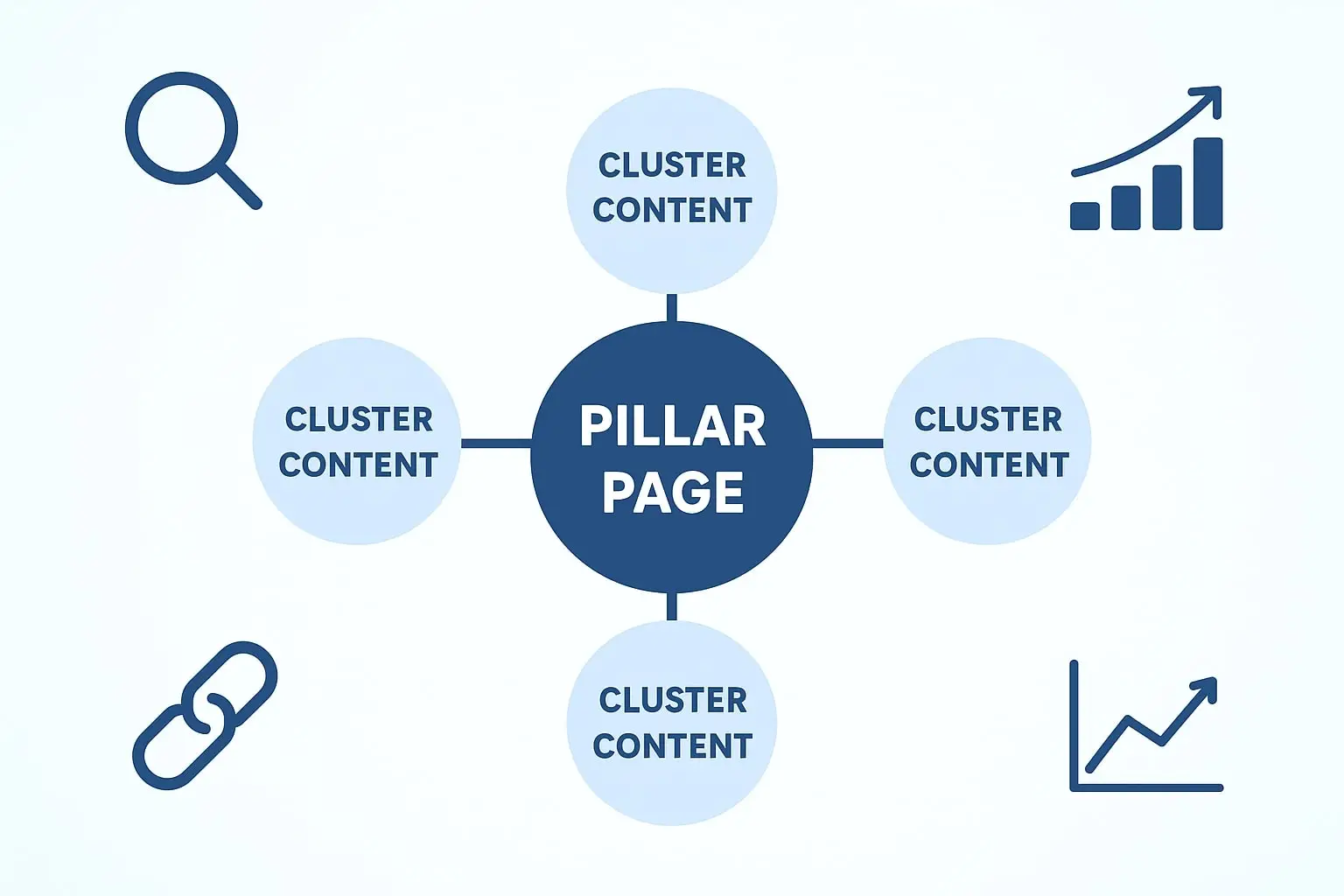
A pillar page is one long, comprehensive article that covers a broad topic in your niche. It doesn’t go too deep into every detail — instead, it gives readers a solid overview of the entire subject and then points them to more detailed posts for each subtopic.
Think of it like a textbook chapter. The chapter introduces the full topic, but directs you to specific exercises or appendices for deeper learning.
Example: A pillar page could be “The Complete Guide to SEO for Beginners” — it covers what SEO is, why it matters, and briefly touches on keyword research, on-page SEO, technical SEO, and link building. Each of those subtopics then becomes its own separate blog post.
What Are Content Clusters?
Content clusters (also called cluster posts) are the supporting articles that go deep into each subtopic from your pillar page. Each cluster post focuses on one specific idea, targets a long-tail keyword, and always links back to the main pillar page.
How Do They Work Together?
The pillar page links out to all the cluster posts. Each cluster post links back to the pillar page. This creates a tight web of related content — and Google absolutely loves it.
This two-way linking structure is what makes content cluster SEO so powerful. It signals to Google that your website has depth and authority on a specific topic, not just random articles scattered across different subjects.
Why Does This Strategy Matter for SEO in 2026?
You might be thinking: “Can’t I just write good articles and rank?” The honest answer is — not anymore. Here’s why pillar and cluster content has become essential.
Google Rewards Topic Authority, Not Random Posts
Google’s algorithm has evolved significantly. It no longer just looks at individual articles, it looks at your entire website to judge whether you’re a trustworthy source on a topic. When your site has a pillar page supported by 6–8 cluster posts all interconnected, Google sees you as an authority. A blog with 30 unconnected posts on random topics? It sees a generalist with no clear expertise.
Internal Linking Becomes Automatic
One of the hardest parts of SEO for beginners is building a strong internal linking structure. The pillar and cluster model solves this problem naturally. Every new cluster post you write automatically has a place to link to (the pillar) and a place that links to it (from the pillar page). You’re building SEO architecture as you create content — without having to think about it separately.
You Rank for More Keywords with Less Effort
Your pillar page targets a broad, high-volume keyword. Each cluster post targets a specific long-tail keyword. Together, they cover an entire keyword universe around one topic. This means one well-structured content cluster can help your site rank for dozens of related search terms, instead of one article trying (and failing) to rank for everything at once.
Pillar vs Cluster Content — What's the Real Difference?
A lot of beginners confuse these two. Here’s a simple side-by-side comparison:
Pillar Page | Cluster Post | |
Length | 2,000–4,000 words | 1,000–2,000 words |
Topic | Broad subject overview | One specific subtopic |
Keyword | Short-tail, high volume | Long-tail, specific |
Purpose | Central hub, builds authority | Deep dive, drives niche traffic |
Linking | Links OUT to cluster posts | Links BACK to pillar page |
Tone | Comprehensive overview | Detailed how-to or guide |
The simplest way to remember it: the pillar page is the “what and why,” the cluster posts are the “how.”
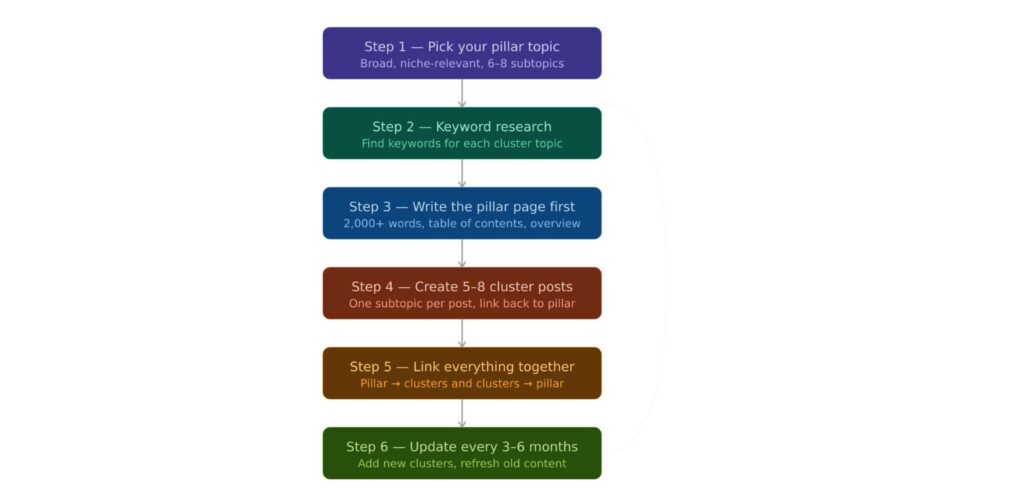
How to Build a Pillar and Cluster Content Strategy (Step-by-Step)
Here’s the exact process I follow — and that you can start today.
Step 1 — Pick Your Pillar Topic
Your pillar topic should be broad enough to have 6–8 subtopics, but specific enough to stay within your niche. For a digital marketing blog like mine, good pillar topics are:
- SEO for Beginners
- Content Strategy for Bloggers
- Social Media Marketing Basics
- Career in Digital Marketing
Avoid going too broad (“Marketing”) or too narrow (“How to write a meta description”). You want something in between.
Step 2 — Do Keyword Research for Cluster Posts
Once you have your pillar topic, brainstorm 6–8 subtopics around it. Then use a free tool like Google Search Console, Ubersuggest, or even Google’s autocomplete to find the exact keywords people search for each subtopic.
For a detailed walkthrough on finding the right keywords, check out my keyword research guide for beginners. It covers the exact process I use for every new content cluster.
Step 3 — Write the Pillar Page First
This is where most beginners go wrong, they write the cluster posts first and never create the pillar. Always start with the pillar page. It gives your cluster posts a home to link back to from day one.
Your pillar page should:
- Cover the full topic at a high level
- Be 2,000+ words
- Have a clear table of contents
- Include links to each cluster post as you publish them
- Follow a strong blog post structure that helps with rankings
Step 4 — Create 5–8 Cluster Posts
Each cluster post should go deep on one subtopic. Write it as if the reader arrived directly from a Google search. Don’t assume they’ve read your pillar page first. Then at a natural point in the article, link back to your pillar page with relevant anchor text.
When writing cluster posts, keep in mind the balance between writing for SEO vs writing for users – both matter, and your content should serve the reader first.
Step 5 — Link Everything Together
Once your cluster posts are live, go back to your pillar page and add links to each one. Then go into each cluster post and make sure it links back to the pillar. This is the step most beginners skip and it’s the most important one for your topic cluster SEO to actually work.
Step 6 — Update Every 3–6 Months
SEO is not a set-and-forget game. Revisit your pillar page every few months, add new cluster posts as you publish them, update outdated information, and check that all internal links still work. A living, updated pillar page continues to grow in authority over time.
Real Example — How I Built This on DigitallyVin.com
Let me show you how this looks in practice using my own blog.
My Content Strategy pillar page (the article you’re reading right now) covers the topic of pillar and cluster content broadly. Around it, I’ve published these cluster posts:
Cluster Post | What It Covers |
How to find keywords for your cluster topics | |
How to format each cluster post for SEO | |
How on-page optimization supports cluster content | |
Technical health checks for your pillar and cluster pages | |
How to write cluster posts that rank AND convert | |
Quick wins while your cluster strategy builds momentum |
Every one of these posts links back to this pillar page. And this pillar page links out to all of them. That’s a complete content cluster SEO structure — and it’s entirely built from posts I’d already written.
The lesson here is powerful: you may not need to write new content. You may just need to connect what you already have.
Common Mistakes Beginners Make (And How to Avoid Them)
After building content clusters on my own blog and studying what works, here are the mistakes I see most often:
1. Making the pillar page too narrow
If your pillar only has 3 subtopics, it’s not a pillar — it’s just a long blog post. A real pillar should comfortably support 6–10 cluster posts.
2. Writing clusters without a pillar first
This leaves your cluster posts “orphaned” — they have nowhere important to link back to, and Google can’t see the connection between them.
3. Forgetting to link clusters back to the pillar
The two-way link is what creates the cluster structure. A cluster post that doesn’t link back to the pillar is just a standalone article.
4. Treating it as a one-time task
The best pillar pages are updated regularly. New cluster posts get added, old information gets refreshed, and internal links get checked. Think of it as a living document, not a published-and-done post.
5. Targeting the same keyword in pillar and cluster posts
Your pillar targets the broad keyword. Each cluster must target a different, more specific keyword. Overlapping keywords creates keyword cannibalization — your own posts compete against each other.
FAQs on Pillar and Cluster Content
1. How many cluster posts do I need per pillar page?
Most SEO experts recommend 5–10 cluster posts per pillar page. For beginners, starting with 5 is perfectly fine. As your blog grows, you can keep adding more cluster posts around the same pillar. The key is that each cluster covers a genuinely different subtopic with its own keyword — not just a variation of the pillar topic.
2. Can a beginner blogger use the content cluster SEO strategy?
Absolutely — and honestly, it’s more valuable for beginners than for established blogs. When your site is new, Google doesn’t know what you’re about. A pillar and cluster structure immediately shows Google your area of expertise, which helps even new sites start building topical authority faster than random blogging ever would.
3. What is the ideal length for a pillar page?
A pillar page should typically be between 2,000 and 4,000 words. It needs to be comprehensive enough to cover the full topic at a surface level, but not so detailed that it eliminates the need for cluster posts. If you find yourself going extremely deep on a subtopic inside the pillar, that’s a signal — pull it out and make it a cluster post instead.
4. Does this strategy work for small blogs with low traffic?
Yes, and here’s why: content cluster SEO is a long-term authority-building strategy. You don’t need existing traffic for it to work — you need consistent structure. Small blogs that use this strategy correctly often see compounding results over 3–6 months as Google begins to recognize their topical expertise.
Conclusion
Pillar and cluster content isn’t just an SEO tactic — it’s a smarter way to think about your entire blog. Instead of publishing random posts and hoping something ranks, you build a connected ecosystem of content that grows in authority over time.
Here’s your simple action plan to start today:
- Pick one broad topic from your niche
- Write a comprehensive pillar page (this article is your template)
- Publish 5–6 cluster posts around it
- Link everything together — both ways
- Update every 3–6 months
You don’t need a massive budget or years of experience to do this. I started DigitallyVin.com as a beginner and this is the exact framework I’m using to build organic traffic from scratch.
Which topic are you planning to build your first pillar page around? Drop it in the comments — I’d love to help you think through the cluster posts!
And if you want more beginner-friendly SEO strategies delivered straight to your inbox, subscribe to the DigitallyVin newsletter. I share practical tips, real case studies, and tools that actually work — no fluff, no jargon.
Loved this guide? Share it with a fellow blogger who’s still publishing random posts and wondering why nothing ranks.