
Table of Contents
ToggleOn Page vs Off Page SEO Guide
If you’re new to SEO, you’ve probably come across terms like On-Page SEO and Off-Page SEO. Both play a crucial role in helping your website rank higher on search engines like Google, but they serve different purposes.
Many beginners focus only on keywords or backlinks without understanding how these two SEO strategies work together. In reality, successful SEO requires a combination of both.
In this beginner-friendly guide, you’ll learn:
- What On-Page SEO is
- What Off-Page SEO is
- On-page vs off-page SEO differences
- On-page and off-page SEO examples
- Why both matter for rankings
- How SEO is evolving in the AI search era
Quick Answer: What Is the Difference Between On-Page and Off-Page SEO?
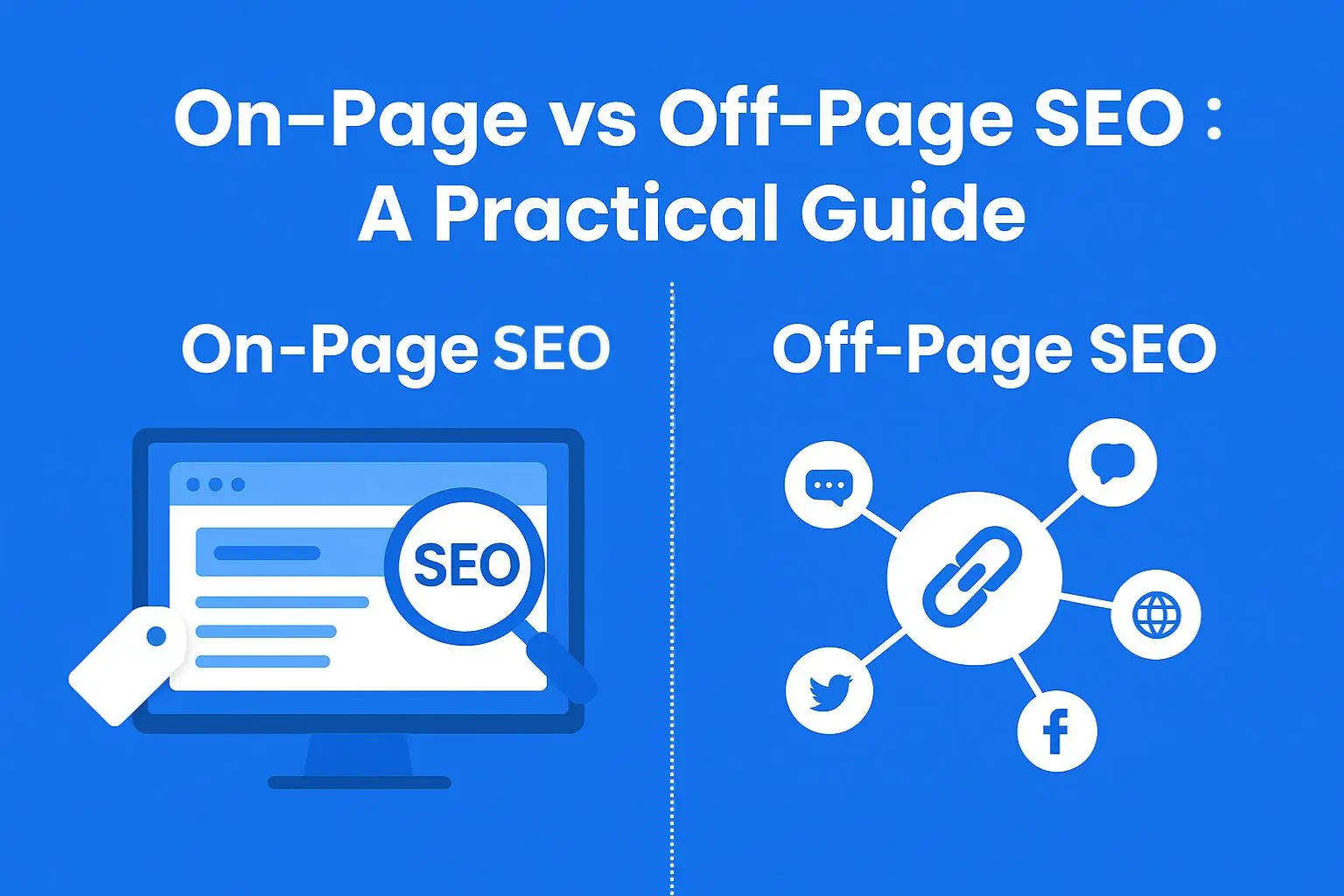
On-Page SEO refers to the optimizations you make directly on your website, such as content, headings, keywords, images, internal links, and user experience.
Off-Page SEO refers to activities that happen outside your website, such as backlinks, brand mentions, guest posting, digital PR, and social media promotion.
In simple terms:
- On-Page SEO improves relevance
- Off-Page SEO improves authority
Both are essential for achieving long-term SEO success.
What Is SEO?
Search Engine Optimization (SEO) is the process of improving your website’s visibility in search engines like Google.
When users search for topics related to your business, products, or content, SEO helps your pages appear in relevant search results.
Modern SEO can be divided into three major areas:
- On-Page SEO
- Off-Page SEO
- Technical SEO
While this article focuses on On-Page and Off-Page SEO, understanding all three is important for building a strong SEO foundation.
What Is On-Page SEO?
On-Page SEO (also called on-page optimization) refers to all the actions you take directly on your website to help search engines understand your content and improve the user experience.
The goal is to make your pages relevant, helpful, and easy to understand for both users and search engines.
Main Elements of On-Page SEO
1. Optimized Title Tags
Your title tag is often the first thing users see in search results. Include your primary keyword naturally while making the title compelling enough to encourage clicks.
2. Helpful Meta Descriptions
Meta descriptions summarize your content and can influence click-through rates. Instead of focusing on a specific character count, write descriptions that accurately explain the page and encourage users to visit.
3. Proper Heading Structure
Using H1, H2, and H3 headings helps organize content and improves readability.
A clear heading structure also makes it easier for search engines to understand your content hierarchy.
4. Strategic Keyword Placement
Effective on-page SEO starts with keyword placement within pages, and that becomes much easier when you’ve done solid keyword research beforehand.
For example:
- On-Page vs Off-Page SEO
- on page vs off page SEO differences
- on page and off page SEO examples
Avoid keyword stuffing and focus on readability.
5. Internal Linking
Internal links connect related pages on your website.
Benefits include:
- Improved navigation
- Better user experience
- Enhanced crawlability
- Increased topical authority
One effective internal linking strategy is using content clusters and pillar pages to improve topical authority and help users discover related content.
6. Image Optimization
Optimize images by:
- Using descriptive file names
- Adding alt text
- Compressing file sizes
- Choosing appropriate image formats
7. Mobile-Friendliness
Most users browse websites on mobile devices. Your website should provide a smooth experience across all screen sizes.
8. Page Speed
Fast-loading websites improve user satisfaction and reduce bounce rates.
9. Search Intent Optimization
Modern SEO is not just about keywords. Your content must match what users actually want when they search.
10. E-E-A-T Signals
Google values content that demonstrates:
- Experience
- Expertise
- Authoritativeness
- Trustworthiness
Including accurate information and practical examples can strengthen these signals.
What Is Off-Page SEO?
Off-Page SEO refers to activities performed outside your website that help improve authority, trust, and credibility.
Think of Off-Page SEO as your website’s reputation across the internet.
When other websites, creators, and communities reference your content, search engines view your site as more trustworthy.
Common Off-Page SEO Techniques
1. Backlink Building
Backlinks are links from other websites pointing to your content.
Quality backlinks remain one of the strongest authority signals in SEO.
2. Guest Posting
Writing valuable content for reputable websites can help you earn backlinks and reach new audiences.
3. Brand Mentions
Even when a website mentions your brand without linking, it can help build visibility and trust.
4. Social Media Promotion
Sharing content on platforms like LinkedIn, Instagram, Facebook, and X can increase exposure and attract visitors.
While social media isn’t a direct ranking factor, it can help generate traffic, backlinks, and brand awareness.
5. Digital PR
Publishing research, expert insights, and unique content can attract mentions from industry websites and publications.
6. Community Participation
Contributing to forums, industry communities, and discussion platforms can increase brand visibility and authority.
On-Page vs Off-Page SEO Differences
Feature | On-Page SEO | Off-Page SEO |
Definition | Optimization performed on your website | Activities performed outside your website |
Focus | Relevance and user experience | Authority and trust |
Control | Fully under your control | Partially depends on others |
Goal | Help search engines understand content | Build credibility and reputation |
Examples | Content, keywords, headings, internal links | Backlinks, guest posting, brand mentions |
AI Search Impact | Improves answer quality and relevance | Improves authority and trust signals |
On-Page and Off-Page SEO Examples
On-Page SEO Example
You publish a blog post targeting:
“What Is On-Page vs Off-Page SEO?”
You then:
- Add the keyword naturally
- Use clear headings
- Optimize images
- Include internal links
- Improve readability
This is On-Page SEO.
Off-Page SEO Example
You promote the same article through:
- LinkedIn posts
- Guest articles
- Industry forums
- Brand collaborations
If other websites link back to your article, your authority increases.
This is Off-Page SEO.
Is Technical SEO Different from On-Page and Off-Page SEO?
Yes. Many beginners think SEO consists only of On-Page and Off-Page SEO. However, Technical SEO is another important component.
Beyond meta tags and headers, there are important technical SEO factors that directly affect how search engines crawl and understand your site.
Technical SEO focuses on:
- Website speed
- Core Web Vitals
- Mobile usability
- XML sitemaps
- Crawlability
- Indexability
- Structured data
Without a technically healthy website, even great content and strong backlinks may struggle to perform well.
On-Page SEO vs Off-Page SEO in the AI Search Era
Search is evolving rapidly.
AI-powered search systems increasingly focus on:
- Helpful content
- Topical authority
- User intent
- Content quality
- Trustworthiness
- Brand reputation
Modern On-Page SEO Includes
- Clear answers
- Comprehensive content
- Semantic SEO
- Topic clusters
- User-focused content
Modern Off-Page SEO Includes
- High-quality backlinks
- Digital PR
- Brand mentions
- Expert citations
- Industry recognition
Websites that perform well in both areas are more likely to earn visibility in AI-generated search experiences.
Why Both On-Page and Off-Page SEO Matter
Many beginners ask:
“Which is more important?”
The answer is both.
On-Page SEO helps search engines understand your content.
Off-Page SEO helps search engines trust your website.
Think of it this way:
- On-Page SEO builds the house.
- Off-Page SEO builds its reputation.
Without On-Page SEO, search engines may struggle to understand your content.
Without Off-Page SEO, your website may lack authority compared to competitors.
Practical Tips for Beginners
If you’re starting your SEO journey, focus on these fundamentals:
1. Do Keyword Research
Find keywords your audience is actively searching for.
Target realistic keywords that match search intent.
2. Create Helpful Content
Write content that genuinely solves user problems.
Focus on quality rather than publishing large volumes of content.
3. Use Internal Links
Connect related articles to improve navigation and topical authority.
4. Optimize Images
Use descriptive filenames, alt text, and compressed image sizes.
5. Build Backlinks Gradually
Focus on earning quality backlinks through helpful content and outreach rather than chasing large quantities of links.
6. Improve User Experience
Make your website easy to navigate, fast, and mobile-friendly.
7. Focus on Topical Authority
Instead of publishing random articles, build content around related topics to demonstrate expertise.
Expert Insight
Many beginners spend too much time worrying about ranking factors and not enough time helping users.
The websites that perform best today usually combine:
- Helpful content
- Strong user experience
- Relevant keywords
- Topical authority
- Quality backlinks
- Consistent publishing
SEO success comes from improving all of these areas together.
Frequently Asked Questions
1. What is the difference between On-Page SEO and Off-Page SEO?
On-Page SEO focuses on optimizing elements within your website, while Off-Page SEO focuses on building authority through external signals such as backlinks and brand mentions.
2. Which is more important: On-Page SEO or Off-Page SEO?
Both are important. On-Page SEO improves relevance, while Off-Page SEO improves authority. A successful SEO strategy requires both.
3. Can I rank using only On-Page SEO?
For low-competition keywords, strong On-Page SEO may be enough. However, competitive keywords often require Off-Page SEO efforts as well.
4. Is backlink building still important?
Yes. High-quality backlinks remain one of the strongest signals of authority, but quality matters more than quantity.
5. Does social media directly improve SEO rankings?
Social media does not directly increase rankings, but it can help generate traffic, backlinks, brand awareness, and engagement that support SEO growth.
Final Thoughts
Understanding the difference between On-Page vs Off-Page SEO is one of the first steps toward building a successful SEO strategy.
To summarize:
- On-Page SEO focuses on optimizing your website and content.
- Off-Page SEO focuses on building authority and trust outside your website.
- Technical SEO ensures your website is accessible and performs well.
- Modern SEO requires attention to user experience, content quality, topical authority, and brand credibility.
Whether you’re a blogger, freelancer, content creator, or small business owner, applying both On-Page and Off-Page SEO strategies can help improve your visibility, attract organic traffic, and build long-term growth.